

Less welding fumes for a better work environment
Shielding gas can minimize the welding fume emission rate
Reducing the amount of welding fume is one of the key challenges in MAG welding. One effective way to improve the working environment is to reduce emissions at their source. With the right shielding gas, both occupational safety and productivity can often be improved simultaneously—directly at the arc.
Reach out to our expertWhat is welding fume and why is it important to reduce it?
In MAG welding, a wire electrode is melted in an electric arc. The extremely high temperatures cause partial vaporization of the electrode. A portion of this metal vapor is necessary for maintaining a stable arc, but a large excess condenses into particles known as welding fumes.
These fine particles, often smaller than 10 µm, are hazardous to inhale because they can penetrate deep into the lung alveoli. To improve the working environment in MAG welding, measures must therefore be taken to minimize particle concentrations. These measures are intended to reduce exposure for both welders and other employees in the affected area.
Prioritising protective measures using the STOP principle
The various measures can be prioritised according to the STOP principle.
This is a structured approach to occupational health and safety that classifies protective measures based on their effectiveness and consists of four levels:
- • S - Substitution: Replacing with a less hazardous alternative (e.g. alternative processes, shielding gases, filler materials, and process parameters) that generates less welding fume.
- • T - Technical measures: Examples include local exhaust ventilation and other systems to reduce the spread of welding fumes.
- • O - Organisational measures: For instance, employee training and optimisation of work processes.
- • P - Personal protective equipment: Such as powered air-purifying respirators, which protect the user but not others in the area.
All of these measures contribute significantly to improving the working environment. In practice, the focus is often on technical measures and personal protective equipment, while substitution is less frequently addressed. Ideally, efforts to reduce welding fumes should begin at the source—that is, at the arc. Shielding gases with a higher argon content reduce the amount of welding fume generated directly at the arc. This, in turn, makes additional measures such as local exhaust ventilation and personal protective equipment more effective.
Our solution for reducing welding fume emissions
The shielding gases MISON® 8 and CORGON® 8 are designed to minimize the formation of welding fumes without compromising productivity or quality. Both gases contain 8% CO₂. The low level of oxidizing gas reduces overheating of the electrode and thereby significantly decreases the formation of welding fumes.
Additional benefits include reduced spatter and oxidation, resulting in less post-weld cleaning and the potential for higher welding speeds due to improved weld pool fluidity.
Read more about MISON Learn more about other welding, shielding and laser gases →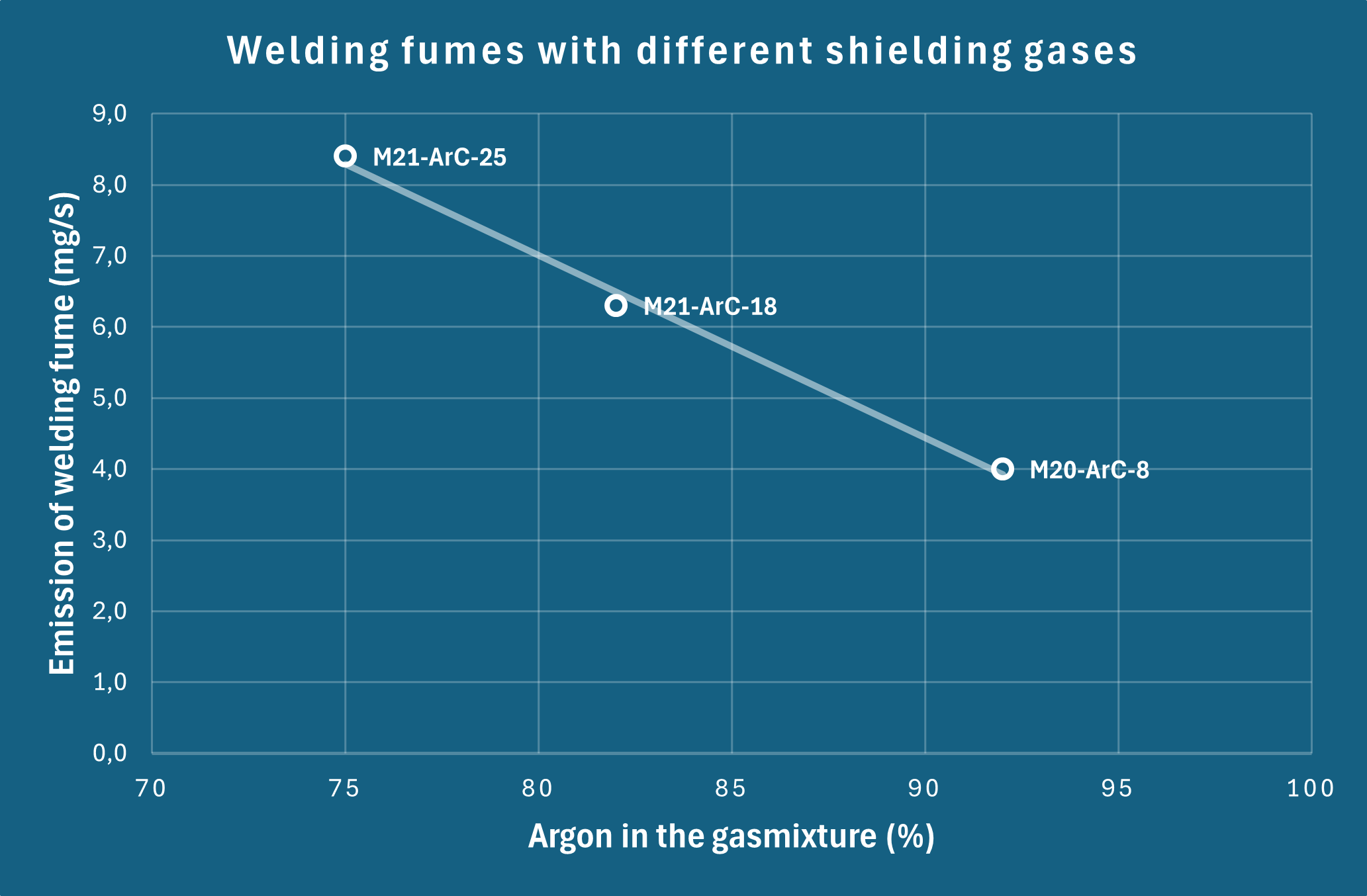
MAG welding of unalloyed steel. Wire feed rate 10 m/min, wire electrode G3Si1/ER70S, 1.2 mm. Measurements in accordance with ISO 15011-1. Source: Linde ArcTech Labs, Unterschleissheim.
DISCLAIMER
All data on welding fume emission rates have been determined in accordance with industry standards (e.g., ISO and AWS) and are provided for reference and comparison purposes only. The welding fume emission rate is only one factor affecting workplace air quality. Your actual welding conditions, materials, procedures, and methods also influence workplace air quality and the welder’s exposure. Users and employers bear sole responsibility and control over workplace conditions, including how work is carried out and which safety measures are applied. Always read and follow all information on product labels and safety data sheets when using products. Safety data sheets can be found via official sources.
WARRANTY DISCLAIMER
Since every welding environment is different, no warranty or guarantee is made that the use of products will reproduce the stated welding fume emission rates. All implied warranties, including fitness for a particular purpose, are disclaimed.